
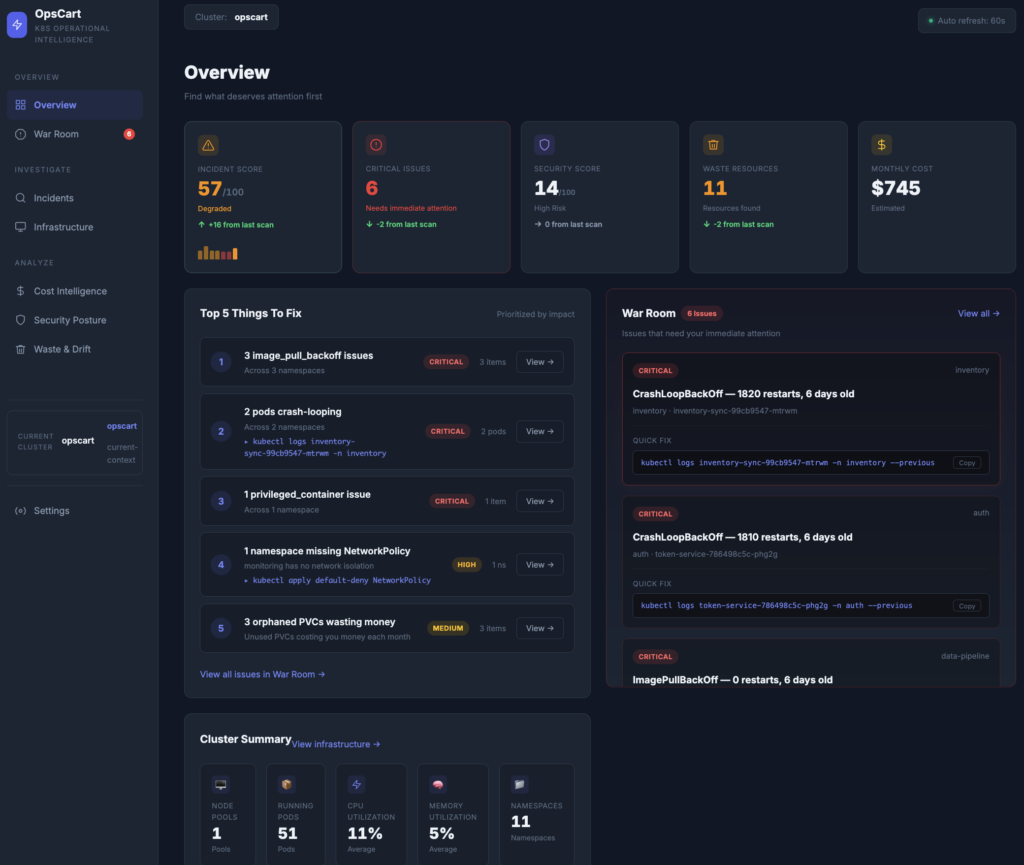
From Bash Script to Operational Triage: What Eight Months of Kubernetes Debugging Taught Me
Kubernetes operational triage taught me that finding failures is easy. Knowing where to start is the hard part.
Kubernetes operational triage taught me that finding failures is easy. Knowing where to start is the hard part.

Docker MCP Gateway is one of the first production tools that takes this seriously — one that treats the infrastructure around the agent as the security layer, not the agent itself.

A DevOps engineer’s hands-on evaluation of Docker Sandbox — network policy findings, isolation proof, and running k3d inside a microVM with a real AI agent scenario.

A practical seven-control checklist for shipping tool-using AI agents to production — identity, authorization, audit, rate limits, rollback, and fallbacks
Production AI Agents in Kubernetes: A 7-Control Checklist for Platform Teams Read More »

Kubernetes has five evidence destruction mechanisms. After the 90-second OOMKill gap, scheduler decisions, debug sessions, and ghost pods vanish silently.
Beyond the 90-Second Gap: Four More Ways Kubernetes Destroys Your Evidence Read More »
Enterprise-grade Docker security guide from managing 8 production clusters. 10 labs covering auditing, hardening, SBOM, escapes. 35,000 words
The Docker Security Guide Fortune 500 Teams Wish Existed Read More »
Debug issues with Kubernetes control plane components and common failure points, including API server, etcd, and scheduler.

How Kubernetes pods accessing Persistent Volumes and common storage failure scenarios.

Kubernetes scheduler assigning pods to nodes, showing common resource and scheduling problems.

A production engineer’s internals guide to ConfigMap sync, in-place resize, Istio xDS, CrashLoopBackOff vs recreation, and Stakater Reloader — verified against Kubernetes 1.35 GA with hands-on lab evidence.
When Kubernetes Restarts Your Pod — And When It Doesn’t Read More »